History of Hahndorf Village
The historic township of Hahndorf is located 28 kilometres south-east from Adelaide, the capital city of South Australia, Australia. It is only a pleasant 30 minutes or so drive from Adelaide via the South-Eastern Freeway (M1) and the ‘Heysen Tunnels’.
Hahndorf was established in 1839 by Prussian Lutheran immigrants fleeing religious persecution and is a small vibrant town with a village type atmosphere. It is located 337m above sea level, has an average annual rainfall of 990 mm, and is located at latitude: -35.0297 and longitude: 138.8104. Hahndorf has a resident population of about 3000 (including its surrounding hinterland). The total land area is 2859 hectares (29 sq km).
Hahndorf & District is bounded by Onkaparinga Valley Road, the Adelaide Hills Council area, Balhannah Road and Birchmore Road in the north, Shady Grove Road, Windsor Avenue, Hogan Road, Nixon Road and Haines Fire Track in the east, Darby Road, Echunga Road, the locality of Echunga, Lubasch Road, Snelling Road, Kangaroo Reef Road, Camelhump Road, Sheoak Road and Sawmill Gully Road in the south, and the Adelaide Hills Council area in the west.
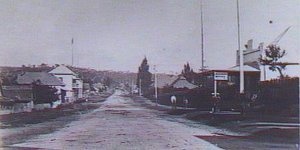
Since its early settlement, Hahndorf has grown and today is still growing. It is no longer a Germanic settlement, but a multi-cultural community. Shady century old trees line the main street, walking down one side and up the other, one passes a kaleidoscope of shops, eating houses and attractions.
There is evidence of the early days throughout Hahndorf as displayed by many of the original buildings still standing and descendants of the early pioneers who have continued to live here.
There is a strong endeavour by most of the Hahndorf community to restore what can be restored of the old and to blend in the new with the old, so that Hahndorf can maintain its charm, character and atmosphere. This is getting more difficult over time.
Hahndorf State Heritage Area
Hahndorf State Heritage Area
(SHA) State Heritage Area, 25 August 1988: State Heritage ID – 13673: Heritage Number – 27557
Hahndorf was settled two years after South Australia was proclaimed a British Province, and declared a State Heritage area on 26th August 1988.
Extract from ‘Hahndorf Conservation Policy’ 1991, p9 – Hahndorf State Heritage Area acknowledges the status of Hahndorf as the oldest (1839) surviving German settlement in Australia.
It is one of the few Australian towns with a significant number of buildings which reflect a distinctive German character.
Its layout is unique in Australia, for unlike Klemzig’s (1838) Strassendorf form and Bethany’s (1842) hufendorf layout, Hahndorf is a combination of both archetypes. It is the oldest surviving German settlement in Australia (Klemzig was the first) and as such presents important facets of the pioneer German way of life.
Its historic character, centered upon Main Street and Victoria Street, arises from its unique plan form and is strengthened by the many surviving 19th century buildings constructed originally in German and then through generations of assimilation, Australian styles, the rhythm of its buildings and open spaces, small rural scale and avenue of trees.
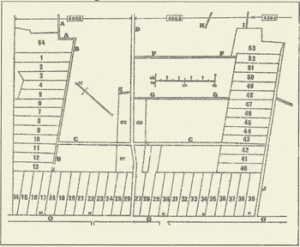
The original planned U-shaped Hufendorf of small farmsteads, with the Lutheran Church (below, now the site of St Michael’s) as the focus. Bounded by Main Road, and the North Lane (now Victoria Street) and South Lane (now English Street).
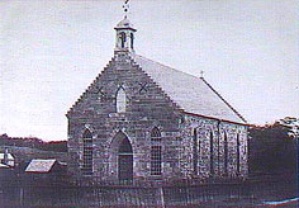
St Michael’s Lutheran Church 1859:
Photo B18229, State Library of South Australia
What's so special about Hahndorf
Hahndorf is Australia’s oldest non-British settlement.
Hahndorf is Australia’s oldest permanent Prussian settlement, established two years after South Australia was proclaimed a British province.
Hahndorf is the first in the hierarchy of permanent Germanic settlements in Australia.
- 1839 Hahndorf
- 1841 Grunthal (now South Verdun)
- 1842 Lobethal
- 1842 Bethany, Barossa Valley
Hahndorf was established as a hufendorf (farm village) in a unique style that had been developed by Germanic people in Europe in the tenth century.
Hahndorf was the first village established east of Mount Lofty.
Hahndorf was the first village to provide Adelaide with fresh food grown in the Mount Barker district. The tradition of fine food and wine lives on today.
Over ninety nineteenth century buildings in Hahndorf’s Main Street, and several others in side streets and the hinterland, provide a picture of the town’s origins as a Germanic settlement and its evolution.
Hahndorf has the best examples of fachwerk (half-timbered) buildings in Australia.
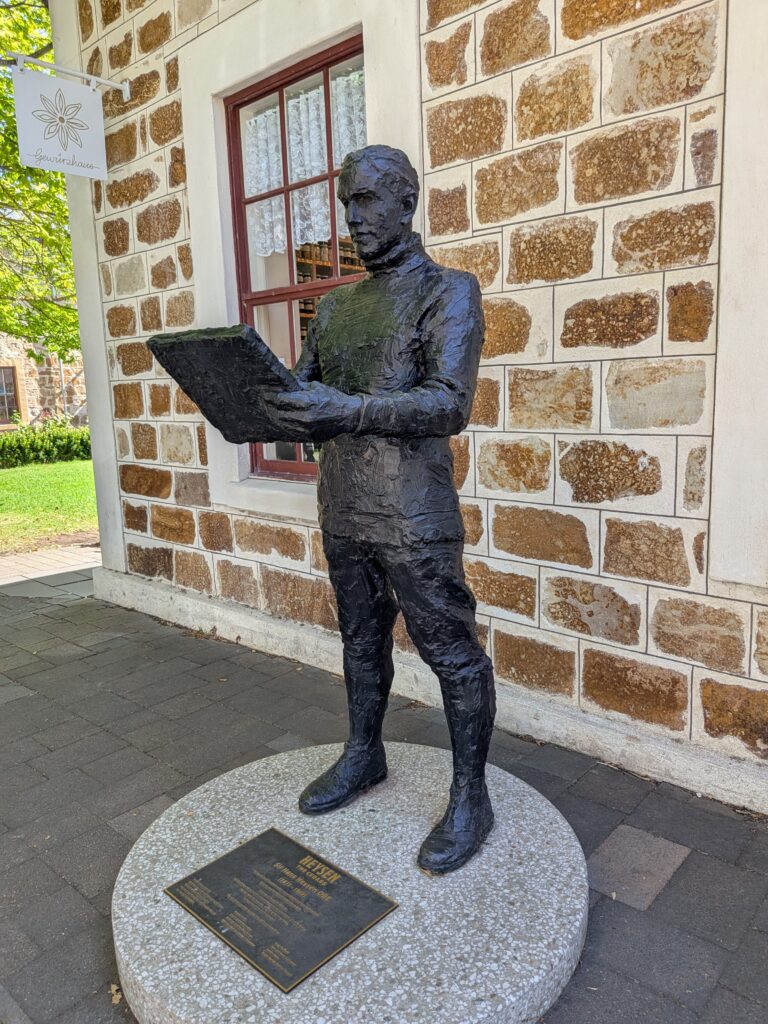
Sir Hans Heysen, one of Australia’s most celebrated artists, made his home in Hahndorf at ‘The Cedars’, which is now open to the general public.
Hahndorf’s historical significance to Australia has been recognised by its listing by the National Estate (1983) and as a State Heritage Area (1968).